







CBAT-O

The Capacity Building Assessment Tool for Organizations (CBAT-O) was developed over a decade ago through a Substance Abuse and Mental Health Services Administration (SAMHSA) grant to help agencies become more trauma-informed.
IDHS and DCFS has contracted with ICOY to assess, train, and work with the Department’s youth services program providers to build trauma capacity. The Department’s goal is to have 100% funded youth services providers achieving and maintaining a “Trauma Informed” status. All IDHS funded sites are expected to participate in the CBAT-O trauma assessment, training opportunities, and suggested action plans, if determined necessary. Sites will not be penalized for their responses or the scores that result from the accuracy of the responses. However, all staff working under an IDHS grant are expected and required to take the CBAT-O assessment
Table of Contents
The What, Why, and What's Next for the CBAT-O
To help you better understand the CBAT-O and how it fits into agency’s trauma-informed efforts, our team has developed a 3-part video series designed to walk you through the process and its purpose. "The What" covers the logistics of the assessment, what it includes, how it's structured, and who is required to complete it. "The Why" explores the purpose of the CBAT-O and explains why participation is required for IDHS funded agencies. Finally, "What's Next" outlines what happens after you complete the assessment, including next steps and our team’s recommendations. If you have any questions after watching these videos, please reach out to us at trauma_initiatives@icoyouth.org.

What is in the CBAT-O?
CBAT-O Structure & Hightlights:
- Online anonymous assessment distributed in the fall of each Fiscal Year
- Divided into 9 total sections
- 84 total questions– every question and/or statement counts towards the overall score of 136 total possible points.
- A score of 102 or higher is considered a “Trauma Informed” status
- The online assessment must be completed in one sitting.
- It can take from 30 minutes up to 1 hour to complete
- The first section of the CBAT-O is "The Trauma Sensitive Environment Checklist." Participants are asked to check each item that occurs at the agency's physical site. For example: "The program requires that staff arrive on-time for youth and families."
- The subsequent eight sections ask participants to assess the agency's level of providing trauma-informed services. For example: "Organization board has youth participants as voting members." All questions require an answer, though some sections may have a "not applicable" option.
Sections of the CBAT-O:
- Trauma Sensitive Environment Checklist
- Organization Structure
- Policies and Procedures
- Supervisor Practice and Support
- Staff Practice
- Leadership
- Training
- Cultural Historical, Gender Identity, and Sexuality Responsiveness
- Community Leadership
CBAT-O Rollout and Timeline
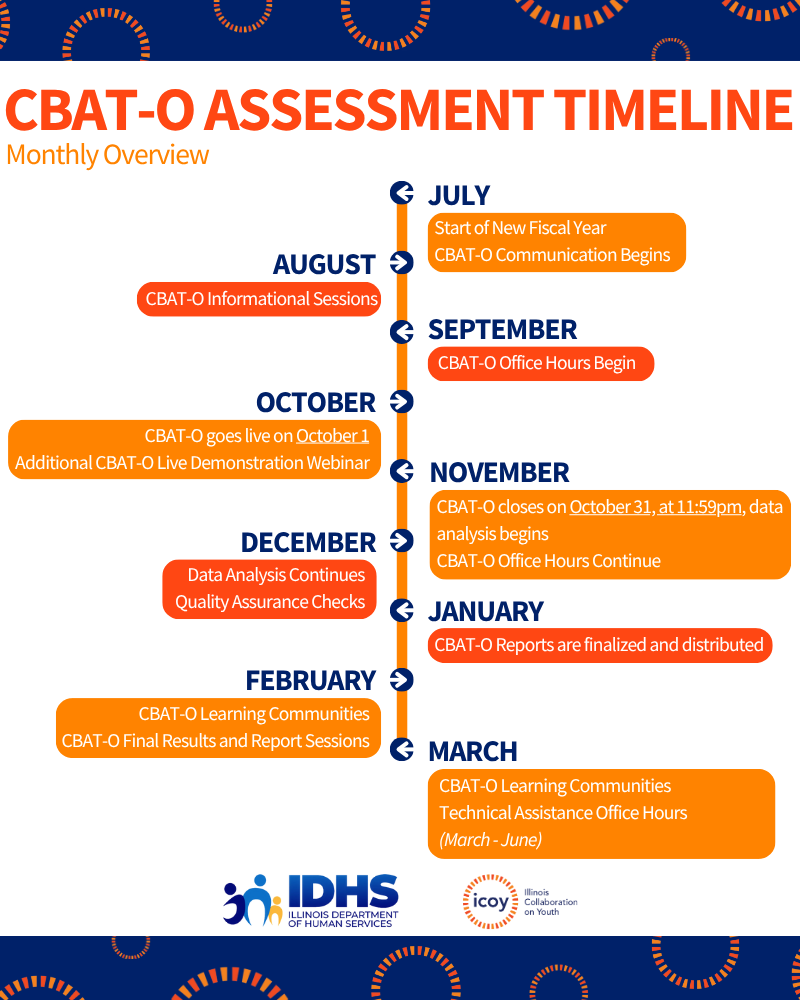
The CBAT-O is administered to all IDHS funded organizations on a fiscal year basis. The online assessment opens in October and closes in November of each fiscal year. ICOY’s Trauma Initiatives Team delivers CBAT-O results and reports to participating organizations in January of every fiscal year. Additionally, all participating organizations are expected to attend a Trauma Learning Community session in the spring.
CBAT-O Learning Communities
ICOY’s Trauma Initiatives Team has introduced a new in-person learning community aimed at supporting providers in integrating trauma-informed practices within their organizations. These learning communities will foster peer-to-peer learning among providers through roundtable discussions, small group interactions, and resource sharing sessions. Structured around the 8 categories of the CBAT-O, the series will feature focus groups and facilitation to guide service providers in crafting strategic plans for trauma-informed implementation. Attendees will be encouraged to conduct a SWOT analysis to assess their organization's strengths, weaknesses, opportunities, and threats.
Furthermore, the sessions will delve into ensuring the sustainability of these strategic plans by addressing crucial topics such as maintaining staff engagement, devising comprehensive education initiatives, and tackling issues like compassion fatigue and burnout.
Office Hours
September - November: Do you have questions about the CBAT-O process? Unsure where to start when reviewing materials? Our Training & Trauma Initiatives Team is here to help answer your questions and concerns. We encourage providers to sign-up for an office hour with us where we can provide more in-depth information and address any questions. We look forward to meeting with you!
February - June: Unsure what the next steps are after receiving your results? Go ahead and sign-up for an office hour with our Training & Trauma Initiatives Team. These sessions are designed for providers to have their questions and concerns addressed around their CBAT-O results and reports. We kindly ask that you bring your specific questions for our team to answer and review your final reports prior to our meeting. We look forward to speaking with you!
Book an appointment during CBAT-O Office Hours with this link! Alternatively, please feel free to email Pearl McRae to do so. Please also find a list of useful links & resources at our team's Linktree.
Resource Library
FAQs
Trauma-informed Care Training Curriculum
CBAT-O Participation
Result Distribution
Still have questions?
Use the button below to reach out to a member of ICOY's Trauma Initiatives team to ask about anything not covered here!


CBAT-O Office Hours
Book a time with ICOY staff to talk about your organization's participation in the CBAT-O.

Register for an upcoming event.
ICOY hosts educational trainings, special events, policy forums, and more.

Attendance Policy for Trainings
Read more about the expectations for participating in an ICOY training